Skip The Obvious
Florence To Lucca: Tuscany At A Slower Pace
Less than 90 minutes from Florence, Lucca is fully walled, largely car-free, and moves at a noticeably slower pace.
- Florence
- ›Lucca

Florence is the center of gravity for most Tuscany trips, and its Renaissance art and architecture justify that completely. Lucca, less than 90 minutes away by train, is a different kind of Tuscan city: fully encircled by intact Renaissance walls, largely car-free inside them, and built on a street pattern that still traces the outline of the Roman town underneath it. It doesn't try to match Florence's density of masterpieces. What it offers instead is a walled, human-scaled city where the pace of a visit slows down almost automatically.
The walls that shape everything
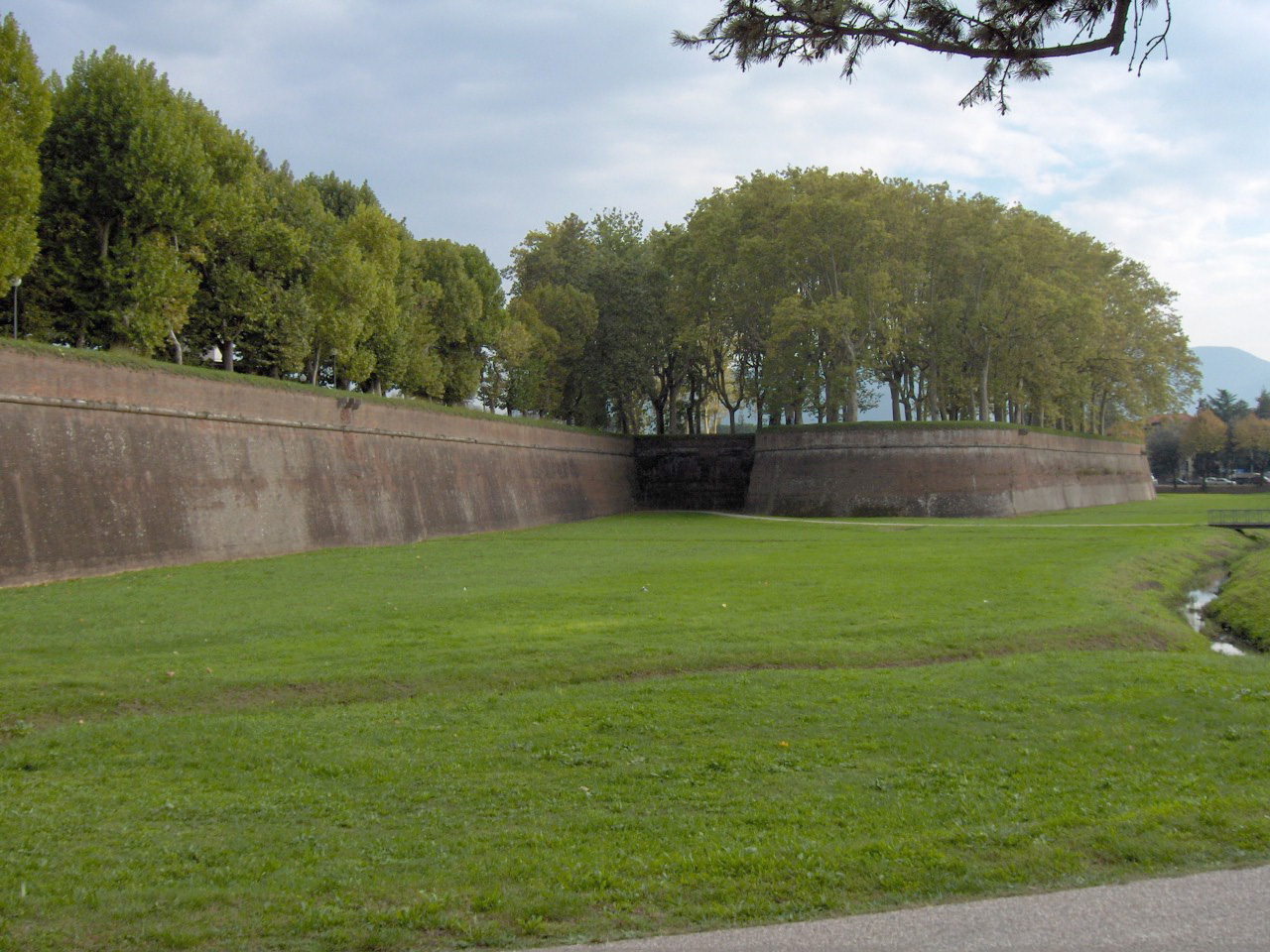
Lucca's city walls, built mostly in the 16th and 17th centuries, were never seriously tested in battle and survived largely intact into the modern era, when most other Italian cities tore theirs down to allow for expansion. Today the top of the walls forms a wide, tree-lined promenade that circles the entire old town, used constantly by locals walking, cycling, and jogging.
Walking the full loop takes a bit over an hour and gives a clear sense of the city's compact scale in a way that's hard to get from inside the streets themselves. It's one of the more distinctive things a Tuscan city has to offer, and there's really no equivalent in Florence.
Piazza dell'Anfiteatro
Perhaps the clearest evidence of Lucca's Roman layer is Piazza dell'Anfiteatro, an oval piazza whose shape follows the footprint of a Roman amphitheater that once stood on the site. Medieval houses were built directly onto and into the old arena structure, and the result is a public square with a shape you don't find anywhere else, ringed by cafes and small shops.
It's a good example of how Lucca layers its history rather than erasing it: Roman bones, medieval infill, Renaissance walls around the outside, all still legible if you know what you're looking at.



The Guinigi tower
The Torre Guinigi, a medieval tower topped improbably with a small garden of holm oak trees growing at its summit, is Lucca's best-known landmark and worth the climb for the view over the terracotta rooftops and the walls beyond them.
Towers like this were once common across Tuscan cities as status symbols for wealthy families, and Lucca and San Gimignano are among the few places where you can still see them in real numbers, though Lucca's version is quieter and less visited than San Gimignano's.
What each city is good at
Florence carries an unmatched concentration of Renaissance art: the Uffizi, the Accademia, Brunelleschi's dome, a level of density that few cities anywhere can match.
Lucca carries a different kind of density, of layered history within a small, walkable, walled footprint, plus a musical heritage (it's Puccini's birthplace) and a food and wine culture tied closely to the surrounding countryside.
- Florence: Renaissance art and architecture, museums, scale of history
- Lucca: intact walls, walkable old center, Roman layout, quieter pace
Puccini's city
Giacomo Puccini was born in Lucca, and the city takes its connection to him seriously, with a house-museum and regular concerts of his music performed in local churches. It's a smaller-scale cultural offering than Florence's, but a genuine one, tied to a specific local figure rather than staged for visitors generically.
Getting there and around
Regional trains connect Florence Santa Maria Novella to Lucca in a bit over an hour and twenty minutes, with reasonably frequent departures through the day. Once inside the walls, the old town is compact enough to cover almost entirely on foot, and renting a bicycle for the wall-top promenade is a common and easy option.
Keep going
Related reading

Routes
Best Stops Between Rome And Florence
The fast train does this trip in ninety minutes. Here is why you might not want it to.
- Rome
- ›Orvieto
- ›Arezzo
- ›Siena
- ›Florence

Routes
A Scenic Route Through Northern Italy
Lakes, mountains and a Roman arena, strung together without a single flight.
- Milan
- ›Lake Como
- ›Bolzano
- ›Dolomites
- ›Verona

Destinations
Alternative Places Near Popular Italian Cities
Italy's headline cities get so much foot traffic that the nearby towns holding the same Renaissance history, often with better food, barely register on most itineraries.
- Ferrara
- ›Mantua
- ›Parma
- ›Lucca
- ›Bergamo
Your Next Trip Doesn't Have To Be A Straight Line
Pick a city you already know, then find the loop around it. That is usually where the trip gets interesting.